

how to stop hypnotizing yourself into a near constant state of fear
The neuroscience behind why your brain fixates on what you don’t want — and how to retrain it for joy.

TL;DR: Most adults are highly skilled at rehearsing what could go wrong. That repetition shapes what feels “normal” and “safe in
theiryour mind. Thus, if you want joy to feel natural, you have to rehearse it on purpose.
After working one-on-one with over 300 people, I’ve seen the same pattern repeatedly: we rehearse what we fear and frame it as safety.
But it’s not safety — it’s repetition. And repetition shapes what feels “normal” to us.
We repeat & rehearse:
the mistakes we don’t want to make again
the outcomes we don’t want to happen
the versions of ourselves we don’t want to be
the feelings we don’t want to feel
From a psychological perspective, this makes perfect sense; your brain evolved to prioritize threat.
So your brain thinks → “If we keep focusing on the danger, we’ll stay safe.”
The ironic part is that constantly rehearsing the unwanted pattern/problem makes it more neurologically available.
To put it simply → what you think about and talk about, your brain flags as important, which means it gets ATTENTION, your precious attention.
Your attention is a training tool, and most people are using it unconsciously. Whatever you train your mind to repeatedly think about becomes the mental “home” you live in.
If you’re constantly saying, “I need to stop being so hard on myself”, your brain has to do three things:
Activate the idea of what ‘being hard on yourself’ means
Scan for if you’re doing it
Monitor whether you’ve stopped

Trying to not think about something ironically keeps the unwanted thought activated — especially if you are under stress.
Why this happens
Your brain is a prediction machine and it’s always deciding what matters based on:
repetition → what keeps happening
emotional intensity → “how activated does this make us?”
perceived threat → what could happen based on what has happened
frequency of attention → how often you think of the thing we’re trying to avoid
Notice what’s missing? Your brain does not prioritize what makes you fulfilled, joyful, or contented. It prioritizes keeping you safe.
So when you constantly think…
“Don’t be so hard on yourself!”
“Stop overeating!”
“Don’t get distracted by your phone!”
“Quit being anxious, everything’s fine!”
Your brain hears → “This is important. To stay safe, let’s keep focusing on it.”
Even if your intention is to eliminate it.

What to Do Instead
The brain builds stronger neural pathways through repetition, so start repeating what you do want.
If you want more joy in your life, you’ve gotta train your brain to see it as safe.
Because joy’s not exclusively a personality trait or something a few people are just lucky to have.
Joy is built by redirecting your attention — repeatedly.
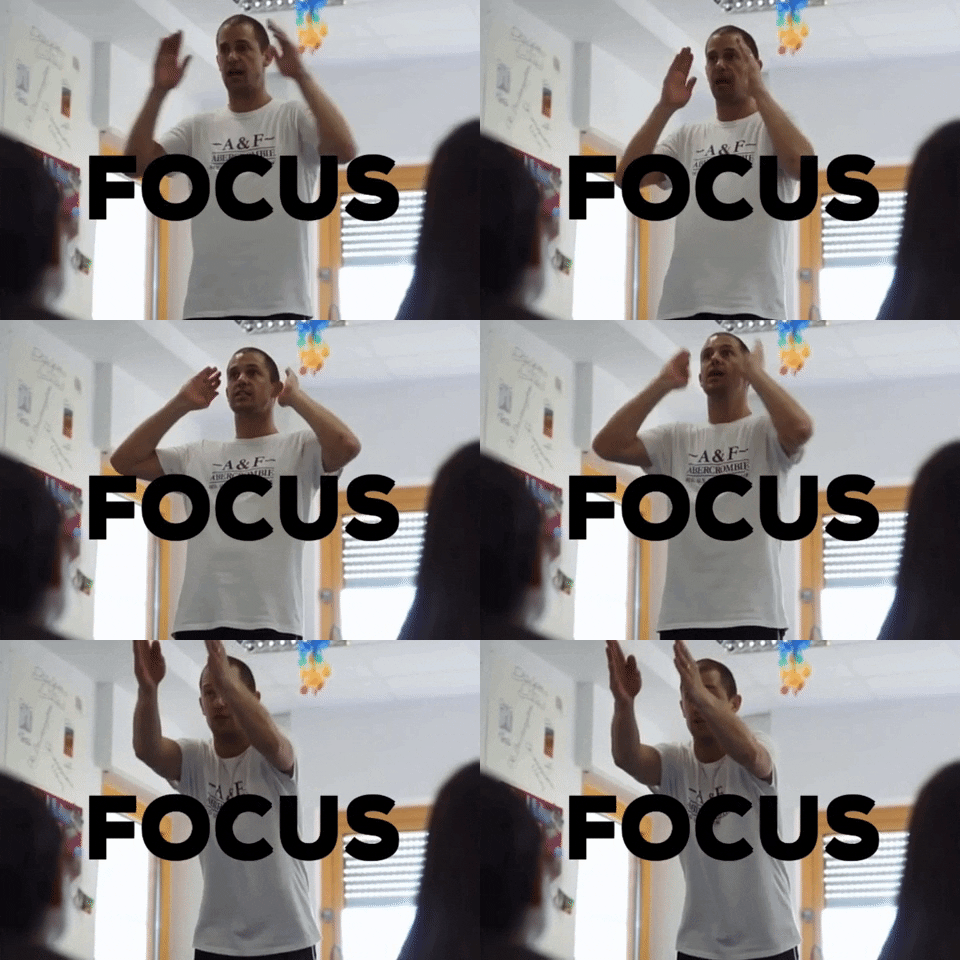
Give your brain a TARGET for what you want it to think about.
Tell your brain what you do want to think about, keep redirecting it, and train it to go there naturally, because over time it will.
You don’t become a joyful person by chasing joy.
You become joyful by training your attention consistently.
It sounds basic because it is, but it’s also a life-changing skill that is 100% free!
Instead of focusing on what you want less of, you are going to draw your attention to what you want more of.
“Don’t be so hard on yourself!” becomes “I’m going to be more gentle with myself today.”
“Stop overeating!” becomes “I’m going to focus on eating more slowly.”
“Don’t get distracted by your phone!” becomes “I’m going to put my phone away.”
“Quit being anxious, everything’s fine!” becomes “I am focusing on deep breaths until I feel some relief.”
Every time you redirect like this, you are practicing joy at the most practical level — by training your brain to notice and move toward what feels aligned, nourishing, and steady.
Toxic Positivity Has No Home Here
This isn’t about ignoring your feelings or glossing over reality.
Actually, to properly make this shift in your thinking, you have to get really up close and personal with all those feelings of yours.
To decide what you want out of life, you’re going to have to be more vulnerable with yourself than you would have to be if you only focused on what you don’t want.
Because when you admit what you do want out of life, it can feel tender because what if you…
» don’t get it…
» can’t have it…
» get it and lose it…
Desire feels risky because it requires hope. And hope requires [at least a tiny sliver of] optimism.
Focusing on what you want will change your perception of the world; your brain will learn to scan for evidence, opportunities, and behaviors that align with what you want, instead of constantly rehearsing what you don’t.
Suddenly, as if by magic, your desires will feel more doable, more likely, and even safer. But it’s not magic, it’s neurological rewiring (ok, maybe it’s a little magic…)


Take Action in 4 Steps
Pay attention to your thoughts, and every time you catch yourself saying, “I don’t want… I need to stop…”
PAUSE
Shift the sentence to, “What I do want is…”
Complete the sentence (out loud if you can) and give your mind something new to rehearse, a direction instead of a warning.
REPEAT, REPEAT, REPEAT
Confidence, joy, and hope strengthen the same way anxiety does: through repetition. The difference is where you aim your attention.
With Joy,
Maggie
P.S. Would you like support getting your brain sailing towards the optimistic side of life? I created a library of hyper-powerful hypnosis tracks you can use for free for a month.



🍵 Enjoying yourself? Buy me a matcha 💚